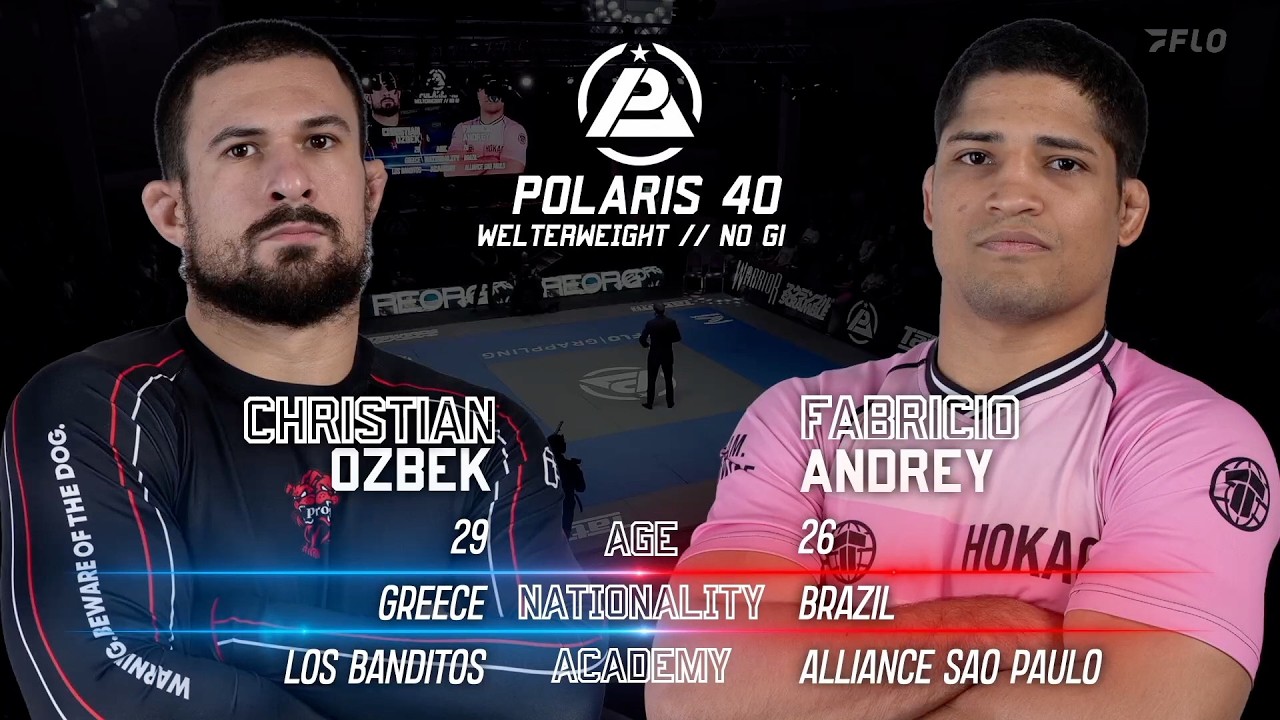
Christian Ozbek, a jiu-jitsu black belt with a judo background, faced Brazilian world champion Fabricio Andrey at Polaris 40, a professional grappling event in Southampton, England.
The November 21 meeting was the middleweight no-gi co-main event at Central Hall. It was a non-title contest on a sold-out card.
The pairing brought contrasting credentials into focus. The footage also prompted debate among viewers about standing exchanges, repeated handshakes and the pace of a match contested across rounds.
The Matchup
Fabricio Andrey, known as “Hokage,” is a black belt who trained under jiu-jitsu coach Melqui Galvao. His achievements include the featherweight title at the 2021 International Brazilian Jiu-Jitsu Federation World Championships. He also won at that year’s Brazilian national championships, commonly called the Brasileiros.
Those results provide the clearest measure of Andrey’s competitive pedigree entering this matchup. His world title came at featherweight, while this Polaris contest was billed at middleweight. That distinction matters when placing his résumé alongside the division listed for this bout. It does not establish either athlete’s actual weight on the night.
Christian Ozbek brought a black belt in jiu-jitsu and experience in judo. That background gives viewers a reason to pay attention to the standing exchanges, particularly how he seeks control before either athlete reaches the mat. It does not, by itself, establish which throws or takedowns he used in this contest.
The available background does not establish Ozbek’s detailed competitive record or either athlete’s current team affiliation. The supported comparison is therefore between Andrey’s documented championship success and Ozbek’s combination of judo experience and black-belt jiu-jitsu.
Instructionals by the athletes in this story
 Destroying Spider Guard & Lasso Guard by Fabricio AndreyView product →
Why This Match Matters
Polaris 40 took place on November 21, 2026, at Southampton’s Central Hall. The sold-out event placed Ozbek and Andrey in the co-main position, giving their middleweight encounter prominent billing.
No championship was at stake in this match. The card’s lightweight title contest paired grapplers Garry Tonon and Sam McNally. For Ozbek and Andrey, the significance lay in the matchup itself: an established Brazilian world champion facing an opponent whose judo background added another point of interest to the contest.
The distinction between championship credentials and the action in this particular match is central to watching it. Andrey’s earlier achievements explain his standing in the sport. Ozbek’s background explains why the battle from the feet deserves attention. Neither résumé alone explains how their exchanges developed.
⚠️ result ahead
Andrey won by decision. Match reporting described him as having the advantage in the first round, with Ozbek recovering ground in the second. That provides a broad outline of the contest without establishing a detailed score or a complete round-by-round account.
What to Watch For
- The emphasis on standing exchanges. Viewers have said that the match contained too much wrestling and too little ground-based jiu-jitsu. Others compared it to a judo match. Those reactions make the standing phase a useful focus: watch whether the exchanges produce meaningful attempts to bring the action to the mat, and how each athlete responds to the other’s control.
- Repeated gestures between the athletes. Viewers have said that fist bumps, handshakes and hand clapping interrupted the contest too often. Pay attention to when those gestures occur and how quickly action resumes afterward. The comments show frustration with the rhythm, but they do not establish friendship or any agreement between the competitors.
- Pacing across rounds. Viewers have argued that the round format encouraged the athletes to conserve energy. Watch for changes in urgency and activity as the bout progresses. That criticism is an interpretation of the format’s effect, rather than confirmation of either athlete’s strategy or physical condition.
- The debate over inactivity. Some viewers called for wrestling-style stalling penalties or broader rule changes. Their objections offer another way to assess the footage: consider which exchanges appear to advance an attack and which appear to reach an impasse. Those reactions do not establish that a specific rule was broken or that an official missed a required penalty.
This match is suited to viewers interested in standing grappling, the interaction between judo and jiu-jitsu backgrounds, and how rounds shape the pace of a contest.
It also offers a concrete match around which to assess the audience debate over activity and entertainment in professional no-gi competition.
Sources: Original video (FloGrappling). Match background is drawn from public sources; the highlights are drawn from viewer comments.