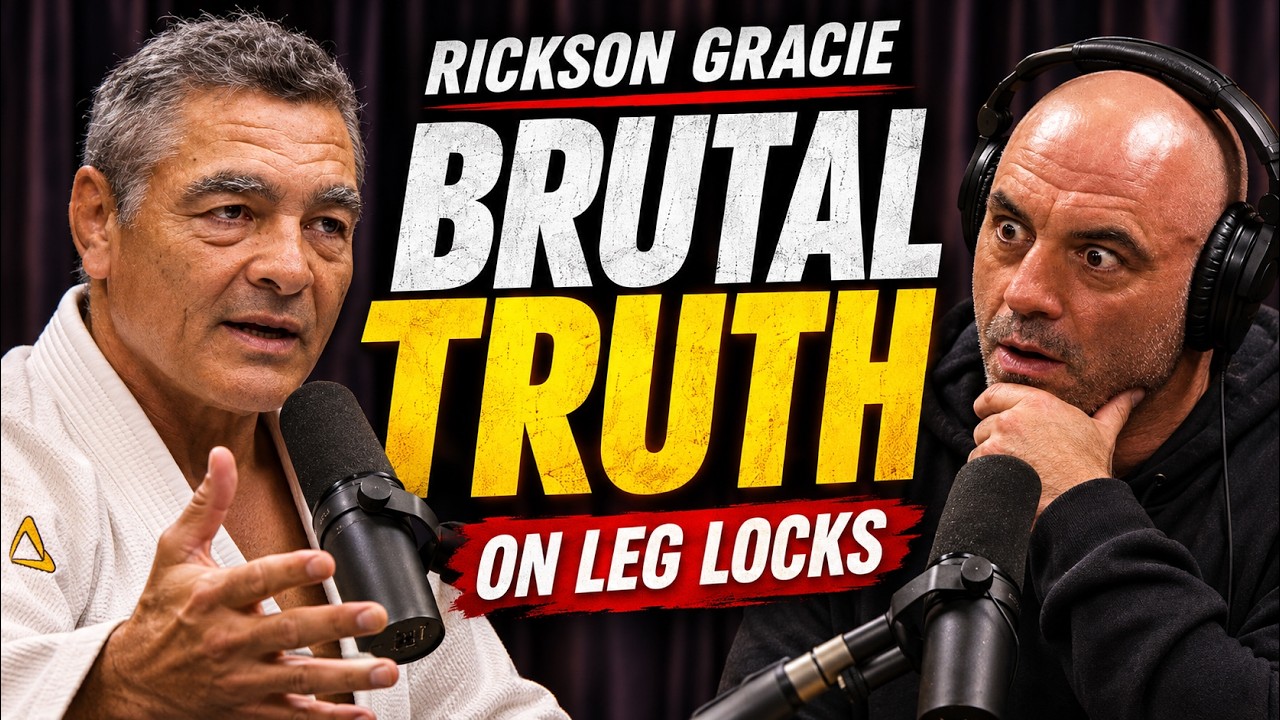
Grappling Archive’s video features jiu-jitsu red belt Rickson Gracie speaking with interviewer Joe Rogan about leg locks, submissions that attack joints in the legs or feet.
The conversation follows their development, the importance of anticipating attacks, and the risks Gracie associates with resisting knee pressure. It then turns to his book, Breathe.
The discussion suits newcomers seeking context and practitioners interested in Gracie’s views on training, injury, and applying jiu-jitsu beyond competition.
Why Gracie embraced leg locks early 00:00
Rogan opens by describing an acceleration in leg lock development over the preceding six or seven years. He credits coach John Danaher and the Renzo Gracie team, a group of jiu-jitsu practitioners, with changing how many no-gi matches unfold. No-gi means grappling without the traditional jacket and trousers.
Gracie responds that he has long liked leg locks. He recalls his friend Erik Paulson, a fellow martial artist, showing him a Shooto tape before a trip to Japan for a Vale Tudo fight, a form of fighting that combines striking and grappling.
The tape featured knee and leg attacks. Gracie connects Shooto, the combat sport shown in the footage, with Satoru Sayama, whom he identifies as Japan’s Tiger Mask.
Foot locks were already familiar to him, but the knee attacks felt new. Inspired by the footage, he says he used them successfully against training partners the next day. Their effectiveness made them feel almost like a shortcut: he could attack a leg and obtain a quick submission.
Defense begins before the finishing position 01:38
Gracie acknowledges that concentrated training has made these attacks more effective. For someone unfamiliar with the escapes, that development changes the contest considerably.
His emphasis, however, falls on recognition. When both partners understand the positions, he expects more preparation and fewer successful leg lock finishes. The defender can react to the approach instead of waiting for the final attack.
Gracie said, "If you get me on a checkmate, it's over." His point is that defensive movement must anticipate the finish. Understanding what an opponent wants creates an opportunity to move before the position becomes decisive.
He describes familiarity with applying and receiving foot locks as something that can eventually become as normal as practicing chokes. Leg attacks then become another submission option within the wider game.
Familiar partners learn to anticipate each other 02:27
Rogan offers an example involving Craig Jones, a grappler he describes as one of the Danaher group. Rogan recounts Jones saying that the partners rarely submit one another with leg locks because everyone knows the positions and defenses.
This is Rogan’s account of Jones’s remarks.
Gracie agrees with the underlying point. Familiarity lets the defender anticipate the attack, making leg locks another part of the technical puzzle.
That does not make them harmless. Gracie stresses that an unaware opponent can lose quickly. His explanation links effectiveness to the gap between an attacker’s knowledge and a defender’s ability to recognize what is developing.
Instructionals close to this article
 Leg Lock Stock And Barrel by Taylor PearmanView product →
Why foot attacks raised concerns about knee injuries 03:13
Gracie warns that resisting certain knee attacks can damage ligaments before the defender feels pain. Rogan then asks about negative crowd reactions to leg locks in earlier jiu-jitsu tournaments.
Gracie initially pushes back on Rogan’s description of the early days, saying the attacks were uncommon. When Rogan asks whether injury concerns contributed to later criticism, Gracie agrees.
He explains that controlling the foot does not necessarily mean pressure remains at the foot. Depending on the attacker’s hip and leg position, the force can affect the knee.
In his account, this created disputes over attacks that looked like foot locks but put pressure elsewhere. He recalls referees stopping matches and issuing penalties for prohibited positions.
Gracie then describes those restrictions as having opened up. He expects defensive knowledge to improve as practitioners train the newly available situations.
Caution matters when learning knee attacks 04:46
Rogan asks whether training and teaching require greater care, especially with beginners. Gracie agrees.
Using his finger as an illustration, Gracie contrasts pressure that produces discomfort before injury with pressure that, in his explanation, can cause damage before pain becomes apparent. He applies that distinction to sideways stress on the knee.
He contrasts this with a straight knee bar, a submission that extends the knee. The warning concerns relying on pain to decide how long to resist.
Rogan raises surgery as a possible consequence and describes knee operations as common among leg lock specialists. The conversation supplies no figures to support a specific injury rate.
Rogan concludes that learning these attacks requires good partners, caution, and correct practice. Gracie agrees that it can be done. The segment offers a training warning rather than a demonstration of grips, escapes, or finishing mechanics.
The two motivations behind Breathe 05:33
The conversation shifts to Breathe, Gracie’s book about his life. Rogan introduces it as being released that day, referring to the conversation’s own timing.
Asked why he wrote it, Gracie answers directly: "First of all, the motivation was money." He says a publishing house made an attractive proposal and that it seemed like a useful opportunity during a difficult period for earning money.
His second motivation was to share the experiences that had shaped him. Those experiences, he explains, helped him grow and seek happiness.
He also describes developing more than physical ability and technique. His account includes mindset, emotional development, and spiritual acceptance as parts of the tools he acquired through life.
Applying jiu-jitsu to an injured body and everyday life 07:03
Gracie outlines the personal material in the book: relationships with his father and brothers, growing up in jiu-jitsu, and partying in Brazil. He presents mistakes as part of the process through which he became a better person.
He then contrasts that personal growth with his physical condition. He describes a bad back and numerous injuries, while maintaining that jiu-jitsu still serves him.
Breathing, visualization, and spiritual guidance are the practices he names. He says he uses what he learned as a fighter to guide everyday life.
The closing emphasis is on sharing experience. By exposing his own life and the ways he addressed its difficulties, Gracie hopes to give readers ideas for changing and improving their own lives.
Names and terms
- Rickson Gracie: The jiu-jitsu red belt interviewed in the video and the author of Breathe.
- John Danaher: The coach Rogan credits, alongside the Renzo Gracie team, with advancing modern leg lock practice.
- Craig Jones: The grappler whose comments about familiar training partners Rogan recounts.
- Leg lock: A broad category of submissions attacking joints in the legs or feet. The discussion includes foot locks and knee attacks.
- Straight knee bar: A submission that applies pressure by extending the knee.
- No-gi: Grappling practiced without the traditional jiu-jitsu uniform, or gi.
This video suits viewers interested in how Gracie connects leg lock effectiveness with defensive familiarity and cautious training. Its final portion also serves readers interested in Breathe and his account of using jiu-jitsu through injury and everyday life.
Sources: Original video (Grappling Archive). This summary is paraphrased from the video's subtitles.