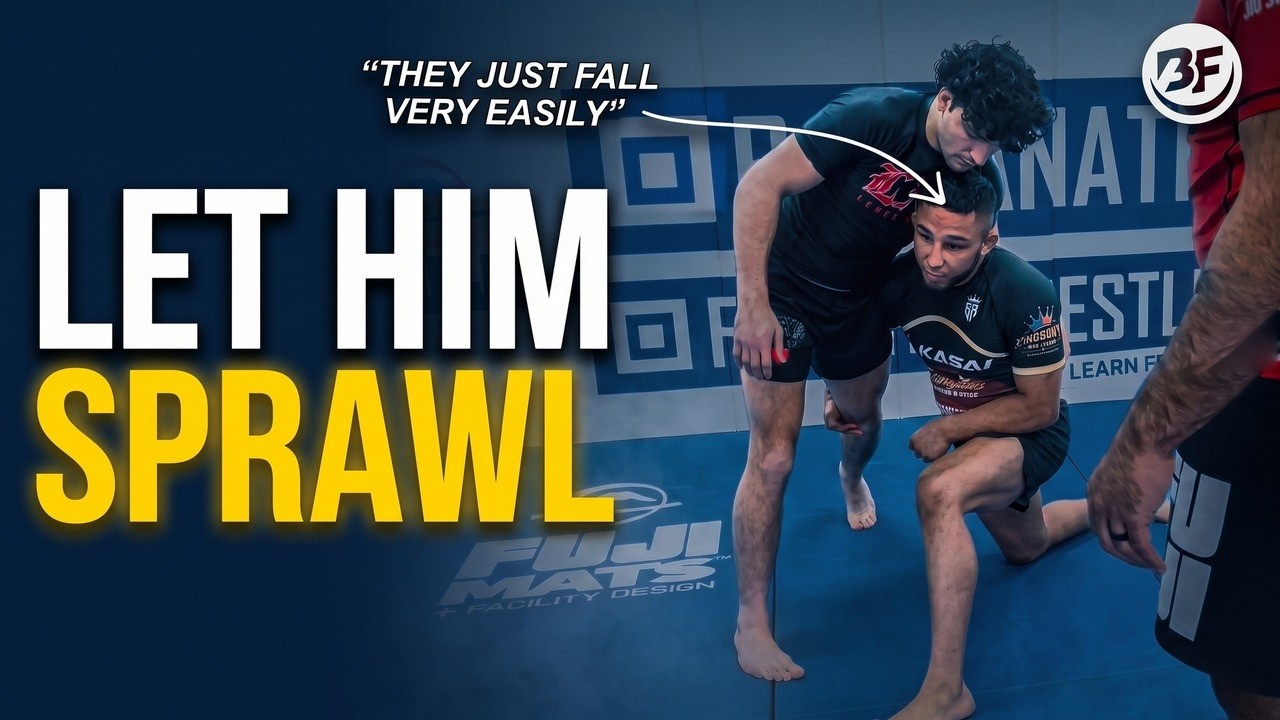
On the Bernardo Faria BJJ Fanatics channel, host Bernardo Faria joins grappling competitor Dorian Olivarez and a training partner to examine takedowns against bigger opponents.
 To beat bigger opponentsBruno Malfacine's beating bigger opponents — full review →
Olivarez explains how he combines changes of angle, arm control and feints before demonstrating a finish called the cutback double. The lesson suits grapplers who want to understand both the entry and the reaction that makes the finish work.
The central idea is to create movement and respond to it, rather than compete directly with a larger opponent’s strength.
Wrestling with submission threats in mind 00:00
The video opens with a preview of the finish. Olivarez enters on one leg, receives his partner’s downward pressure and steps across the partner’s body to complete the takedown.
Faria then introduces Olivarez and his instructional course, Read, React, Fight. Asked about his system, Olivarez distinguishes wrestling for jiu-jitsu from folkstyle and freestyle, two wrestling rulesets.
His preferred attacks either take him behind the opponent or put him in control of both legs. Submission threats influence those choices. He wants positions where he is less concerned about a guillotine, a choke applied around the neck from the front.
That explains the emphasis on arm drags and attacks that create access to the opponent’s side or back. The objective includes the position reached after the entry, not simply getting hold of a leg.
Creating angles before committing to an attack 02:16
Olivarez compares his standing approach to guard passing. In ground grappling, the passer works around the guard player’s legs to reach a controlling position. Here, he applies a similar emphasis on finding useful angles.
He can create an angle by moving himself or by moving the opponent. He acknowledges that he sometimes attacks straight ahead, but describes angle creation as his usual approach.
- Use the standing tie-up to establish inside control and move the opponent.
- Change position around the opponent, or pull the opponent into a position that opens an attack.
- Follow the movement into a single-leg attack, a downward pull, front head control or a route behind the opponent.
The mistake he cautions against is remaining directly in front of the opponent as the default attacking position. The tie-up should help produce movement and a better angle.
The baseball-bat grip provides another route 03:01
Olivarez next demonstrates a grip he calls the baseball bat. Both hands hold the opponent’s arm in a manner resembling a grip on a bat.
Faria points out that this differs from the traditional two-on-one arm-control position. Olivarez describes it as an underused option and shows how it supports the same objectives as his other controls.
- Hold the opponent’s arm with both hands in the demonstrated baseball-bat grip.
- Use the arm control to move the opponent and create an angle.
- Alternatively, pull the opponent downward so the hands reach the mat, then move behind.
The grip is part of the wider system. Olivarez repeatedly returns to two outcomes: gaining an angle or forcing the opponent down far enough to expose a route to the back.
Instructionals by Dorian Olivarez
 Wrestle, Pass, Submit Bundle by Dorian OlivarezView product →
Feints connect the leg attack and downward pull 03:46
The discussion turns to feints, movements that suggest an attack and invite a defensive response. Olivarez uses different feints at distance and in the clinch, the standing position where the athletes have established close contact.
In the clinch, he demonstrates threatening the legs to draw a reaction. What happens next depends on the opponent’s response.
- Threaten a leg attack while maintaining the standing engagement.
- If the opponent reacts, use that response to create the downward pull.
- If the opponent does not react, continue into the takedown.
Olivarez explains: "And if he doesn't react, then I use that for my takedown." The feint therefore leads into a choice, rather than serving as movement without a follow-up.
Faria identifies downward pulls, angle changes and feints as recurring features of Olivarez’s competition game. Olivarez adds arm drags, which move an opponent’s arm across to help open a path behind.
Adjusting the grips against a bigger opponent 04:31
When Faria asks about facing larger opponents, Olivarez says he avoids clinch situations that become contests of strength.
A neck grip can be harder to use when the opponent is taller. Reaching and pulling the head down becomes more difficult. His response is to work more through the wrists and arms.
- Favor wrist control and arm attacks when the opponent’s height makes head control difficult.
- Use arm drags and the baseball-bat grip to create movement.
- Keep using feints to draw reactions that make a takedown available.
He then introduces the cutback double as one of his finishes after a feint. He cites his match with Felipe Pena, an opponent mentioned in the video, as an example of using this sequence.
Finishing the cutback double against the sprawl 05:16
The sequence starts with a feint and an entry on one leg. Olivarez then looks for the opponent’s defensive reaction.
He expects a sprawl: the opponent sends weight downward over the attacker to defend the leg entry. Against a bigger opponent, that pressure becomes the cue to change sides.
- Use the feint to draw a reaction, then enter on a single leg.
- Recognize when the opponent sprawls and puts weight onto the entry.
- Step across the opponent’s body and move to the other side.
- Pull the opponent’s knee toward you as you circle to complete the takedown.
Faria highlights the switch from the original side to the opposite side. Olivarez repeats the demonstration from another orientation so that the step across is easier to follow.
The key detail is the relationship between the pressure and the step. Olivarez changes position while the opponent is pressing down on him. He does not describe lifting the opponent against that weight.
He says the finish can leave him past the guard, or put the opponent on their back with the exchange continuing from there.
A deliberate plan behind the movement 06:46
Faria observes that Olivarez’s competition style can look like a product of athleticism, while the explanation reveals deliberate decisions behind the attacks.
Olivarez returns to his plan against larger opponents: work more at range and use hand attacks, feints and movement to create takedowns and score points.
The closing discussion presents Read, React, Fight as a step-by-step explanation of that system. Faria says the course will be available through BJJ Fanatics, the instructional-video provider featured in the video.
Names and terms
- Dorian Olivarez: The grappling competitor demonstrating his standing attack system and cutback-double finish.
- Bernardo Faria: The host who asks Olivarez to explain his decisions and highlights details during the demonstration.
- Single-leg takedown: An attack that begins by controlling one of the opponent’s legs.
- Sprawl: A defensive response that brings weight down over an opponent attacking the legs.
- Cutback double: The finish shown here, in which Olivarez changes sides from a single-leg entry as the opponent applies downward pressure.
- Arm drag: An arm-control action used to create an angle and access to the opponent’s side or back.
This video suits grapplers looking for a standing approach against bigger opponents. The repeated cutback demonstration is particularly useful for following how a defensive reaction becomes the cue for the finish.
Sources: Original video (Bernardo Faria BJJ Fanatics). This summary is paraphrased from the video's subtitles.