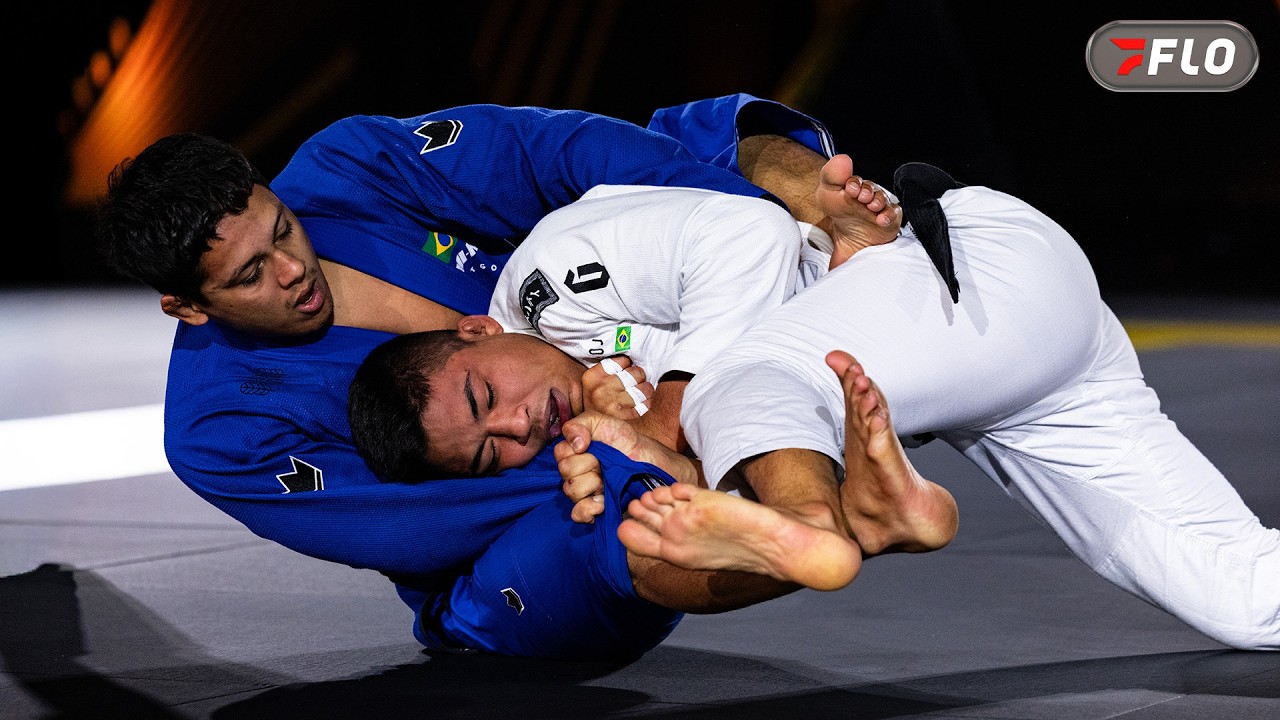
Mica Galvão’s victory at The Crown replaced a two-year middleweight champion and demonstrated how quickly the IBJJF invitational can reorder its championship field. Making his event debut on November 8 at the Walter Pyramid in Long Beach, California, Galvão won three matches to claim the 82.3kg title. His decisive result was a 4-2 final victory over Andy Murasaki, the champion in 2024 and 2025.
The Crown is a professional gi competition separate from the IBJJF’s four major tournaments, bringing 48 invited athletes into six eight-person brackets for a single day. Each division carries an announced $20,000 first prize, with exclusive coverage on FloGrappling. For Galvão, a Manaus-born black belt who established himself among the leading gi and no-gi competitors as a teenager, that format offered an immediate route back to a major title after spending much of 2026 away from major gi events.
FloGrappling returned to the championship run on November 26, promoting all three matches more than two weeks after the tournament. The competitive change had already happened. The renewed promotion extended its commercial life, turning the complete route to gold into another reason to revisit the broadcaster’s archive.
Murasaki’s two titles set the standard Galvão displaced
Before this edition, middleweight continuity belonged to Murasaki, an AOJ competitor who had won The Crown in consecutive years. His 2024 and 2025 titles provided the clearest precedent for the 2026 final: he had already demonstrated that an eight-person invitational could produce a repeat champion rather than a different winner every year.
Galvão changed that pattern on his first appearance. Murasaki reached another final, putting himself one victory away from a third consecutive championship, but the returning contender won the exchange that decided the bracket.
The distinction matters when assessing the result. Galvão did not inherit an empty championship position or win a division from which the defending champion was absent. He defeated Murasaki directly, ending the titleholder’s run at its final obstacle.
Galvão also arrived with a substantial gi record of his own. He became a black belt at 17 and completed the IBJJF Super Grand Slam in 2024. Those achievements supplied the competitive context for his return, but they did not give him a shortcut through The Crown. Like every entrant in the division, he needed three victories on the day.
Three victories came through three different problems
The opening match against Leonardo Souza, also known as Leo or Leleo, finished 4-2 to Galvão. Souza was the first opponent in the eight-person bracket, and that points victory moved Galvão into a semifinal against Matheus Luna.
The semifinal produced the most disputed ending of the run. Luna was disqualified during the exchange, sending Galvão through to the final. Published match reports have not detailed the official basis for the ruling.
The result was a disqualification victory, not a completed submission. That distinction separates Galvão’s attacking position from the ruling that formally ended the match. It also explains why the semifinal generated a discussion about the competition area and officiating alongside the usual assessment of technique.
The earlier coverage of Galvão’s semifinal against Luna examined that encounter. The November 26 promotion places it within the full championship sequence: a points win over Souza, the disqualification against Luna and a final against the reigning champion.
Instructionals by Mica Galvão
 Next Generation Closed Guard by Mica GalvaoView product →
Against Murasaki, the decisive movement came late. Galvão used successive sweeps to reach a 4-2 winning score. A sweep reverses the bottom and top positions from guard, making the late reversals consequential scoring actions rather than simply changes in control.
- Opening round: Galvão defeated Leonardo Souza 4-2 on points.
- Semifinal: Galvão advanced when Matheus Luna was disqualified; the official basis for the ruling has not been detailed in published reports.
- Final: Galvão defeated two-time champion Andy Murasaki 4-2 after late sweeps.
Together, the matches show why the final score alone does not explain the title run. Galvão advanced through two points decisions and an officiating decision, with each stage presenting a different route to the next round.
A single-day bracket changed the title picture
Launched in 2023, The Crown reached its fourth edition in 2026. Its structure compresses an entire championship campaign into one day: eight athletes enter each division, and one leaves with the title after three rounds.
Murasaki’s previous success showed that the format could reward sustained superiority across editions. Galvão’s debut demonstrated its capacity for an immediate change. A competitor returning from an extended absence could enter the invitation field and remove an established champion without first building a season of results at the major gi tournaments.
That does not make The Crown interchangeable with the World Championship or the wider IBJJF calendar. Its significance is more specific. The invitation determines access, but the bracket then forces the selected athletes into direct elimination matches, with a championship and an announced $20,000 prize attached to the outcome.
Galvão’s victory therefore changes the middleweight reference point for this event. Murasaki remains its 2024 and 2025 champion; Galvão now holds the title after beating him head-to-head.
FloGrappling gives the November 8 run a second window
The November 26 post shifted attention from the live result to the complete viewing experience. FloGrappling, The Crown’s exclusive broadcaster, promoted the three-match run as a package rather than isolating only the championship final.
That approach gives the archive continuing value. The opening round supplies the start of the campaign, the semifinal contains its disputed ruling, and the final delivers the championship change. For viewers returning after the event, those are three connected reasons to watch.
The distinction between the two dates is central to the story. November 8 produced a new champion. November 26 renewed the distribution of the performance, showing how an invitational’s value can continue beyond its single day of competition.
What people are saying
Discussion around the tournament and published match footage has divided between praise for Galvão’s return and criticism of the semifinal’s ending.
- Some favored stopping the action and returning the athletes to the center instead of ending the match.
- Others argued that major matches need a larger competition area to reduce boundary disputes.
- Some interpreted Luna’s movement as a submission escape and questioned the disqualification.
- Another view sought a middle ground between continuing beyond the boundary and ending exchanges too quickly.
- Supporters of Galvão saw the title as evidence that his time away had not removed him from the top of gi middleweight competition.
Galvão’s three victories settled the 2026 championship, but whether he can turn a successful debut into the sustained control Murasaki established remains the key question for The Crown’s middleweight division.
Sources: FloGrappling; IBJJF.