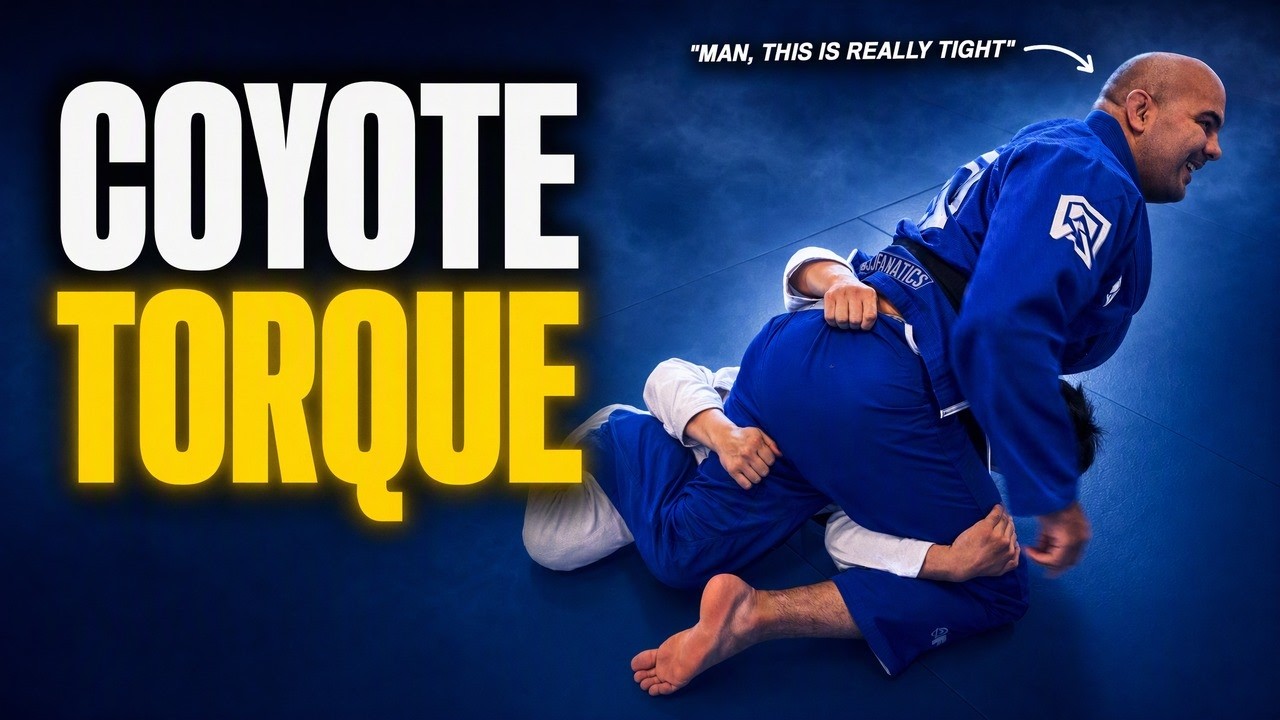
On the Bernardo Faria BJJ Fanatics channel, host Bernardo Faria welcomes Korean jiu-jitsu practitioner Jun Yong Cho for a demonstration of his Coyote Half Guard variation.
Half Guard is a bottom position in which the guard player controls one of the passer’s legs. Cho demonstrates how changing the foot configuration creates rotational pressure that helps turn that position into a sweep, reversing who is on top.
The video follows the setup, the response to a heavy knee and Faria’s comparison with the traditional version. It suits practitioners who already use Half Guard and want to understand the finishing detail.
Introducing the Coyote Half Guard variation 00:00
Faria introduces Cho’s adjustment as a new way to create torque, or rotational leverage, from Coyote Half Guard. In this demonstration, the guard player uses the legs to control and turn the passer’s trapped foot while working toward a sweep.
The opening frames the detail as part of Cho’s broader Coyote Half Guard instruction. Faria says Cho has already shown him the movement and invites him to demonstrate it with Dustin, the training partner in the video, before trying it on Faria himself.
The central question is how Cho crosses his feet. As the demonstration develops, Faria repeatedly returns to that configuration and the pressure it places on the trapped leg.
Responding to a heavy knee 00:45
Cho begins by grabbing the passer’s ankle. He explains that the passer can keep the knee heavy, making a straightforward pull difficult. His response combines a change in body position with pressure against the foot.
- Take hold of the passer’s ankle from the demonstrated Half Guard position.
- Move down onto the stomach when the passer keeps the knee heavy.
- Use the heel to put pressure on the passer’s foot.
- If the passer moves the knee backward, move in and hug the far leg around the thigh.
The far-leg connection follows the passer’s reaction. Cho does not describe completing the whole movement through an ankle pull alone. He changes his position first, then reaches around the other leg when the knee moves back.
Apply the torque, then wait for the sweep 01:30
Once connected to the far leg, Cho applies a strong sweeping effort but does not immediately complete the reversal. He says, "I won't do the sweep right away." He maintains the torque and waits for the passer to concede the position.
Faria asks for another demonstration with the camera behind the action. He then asks whether the new detail is the way Cho crosses his legs. Cho confirms this and explains that he turns the passer’s ankle sideways.
- Use the crossed-leg configuration to turn the trapped ankle sideways.
- Maintain the sweeping pressure rather than expecting an immediate reversal.
- Wait for the passer to give up the position under that pressure.
- Complete the sweep as the passer yields.
Instructionals by Jun Yong Cho
 Cho's Coyote Half Guard by Jun Yong ChoView product →
Cho describes pressure reaching the knee. That pressure is the reason he gives for the passer being unable to remain in place. The sequence depends on maintaining the position long enough for that reaction.
Why pulling alone is not enough 02:15
Cho returns to the problem of the heavy knee. If he only pulls, the passer can remain heavy. Lying face down changes how he can apply the pull.
Faria distinguishes this adjustment from the leg twisting already present in traditional Coyote Half Guard. He asks whether the difference comes from the crossed legs together with the arms wrapped around the passer’s leg. Cho confirms the explanation.
At 03:00, Faria takes the passer’s role to feel the movement. During this exchange, the demonstration includes a caution about a bad knee. Faria then identifies the visible detail: Cho crosses both feet and applies pressure to Faria’s heel.
The repeat makes the earlier explanation more concrete. The crossed feet control the heel, the trapped leg comes under rotational pressure, and the passer gives up the position. Cho also confirms that he tries to use this leverage when playing Coyote Half Guard.
Developing the detail and using it without a gi 03:45
Faria asks how Cho develops these technical adjustments. Cho answers, "Oh, we're not that big." He explains that they need to create techniques to complete sweeps or submissions, holds intended to make an opponent concede.
The discussion then turns to clothing. A gi is the jacket-and-trousers uniform used in one form of jiu-jitsu. No-gi grappling takes place without that uniform.
Cho says he uses the adjustment in no-gi too. However, he usually competes and uses it in the gi. The video then returns to the same demonstration on Faria rather than presenting a separate no-gi sequence.
Comparing the traditional hold with Cho’s adjustment 04:31
Faria asks Cho to alternate between the traditional Coyote configuration and the new version so he can feel the difference. He describes the traditional hold as being almost like a triangle around his heel.
With Cho’s adjustment applied, Faria says it feels as though his foot is being trapped. He adds that it almost feels like a calf lock, a compression hold affecting the calf. This is his description of the sensation during the demonstration; the technique being taught remains a sweep.
- Compare the traditional leg configuration with Cho’s crossed-foot adjustment.
- Observe the added control around the heel and trapped foot.
- Connect that control to the upward pull and sweeping direction shown in the demonstration.
At 05:16, Faria closes by describing the adjustment as part of Cho’s wider Coyote Half Guard system. Cho confirms that he applies the torque across much of that work. The remaining footage promotes the instructional material and the channel.
Names and terms
- Jun Yong Cho: The Korean jiu-jitsu practitioner demonstrating the crossed-foot adjustment and resulting sweep.
- Bernardo Faria: The host, who asks Cho to repeat the movement and compares the two versions by feeling them himself.
- Coyote Half Guard: The Half Guard variation demonstrated here, using control of the passer’s trapped leg to help produce a sweep.
- Sweep: A reversal from a guard position that brings the guard player from underneath to the top.
- Torque: Rotational force. Cho uses the term for the pressure created by controlling and turning the passer’s trapped foot.
- Gi and no-gi: Grappling with the traditional jacket-and-trousers uniform, or without it.
This video is most useful for Half Guard practitioners whose sweeps stall against a heavy knee. The repeated demonstrations help viewers follow the crossed feet, heel pressure and pause before the reversal.
Faria’s side-by-side comparison also gives viewers a specific detail to watch: how Cho’s adjustment changes control of the trapped foot.
Sources: Original video (Bernardo Faria BJJ Fanatics). This summary is paraphrased from the video's subtitles.