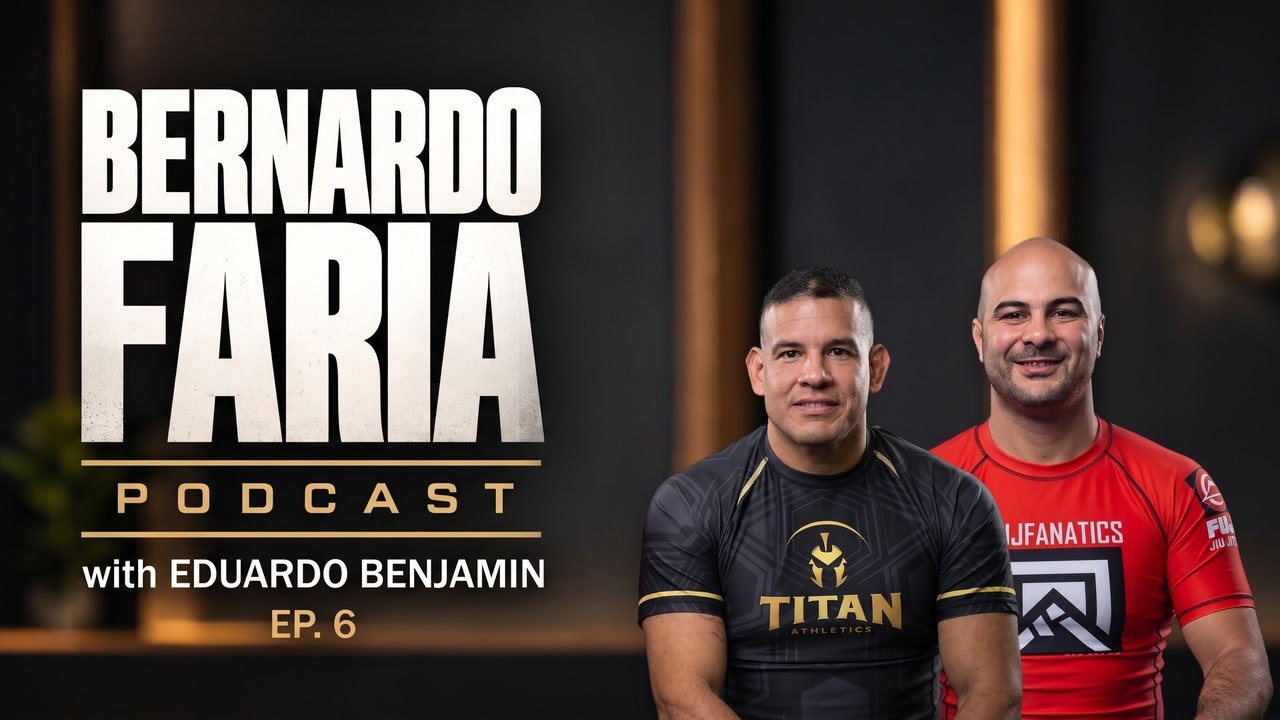
Eduardo Benjamin, a police chief and founder of Titan Athletics in Brewer, Maine, joins jiu-jitsu instructor and podcast host Bernardo Faria to discuss training, policing and community service.
Benjamin describes his gym as a place to recover from demanding work. He explains why he left a franchise, how he welcomes beginners and why officers must accept being students.
The conversation also covers continuing education, assistance for local residents and a student's recovery from heroin addiction.
A police chief's place to unwind 00:01
The video opens with an excerpt about ego. Benjamin describes a 200-pound officer being controlled by a 130-pound training partner. Accepting that experience, he says, is part of improving.
Faria then introduces Benjamin at Titan Athletics, the gym he is visiting for a second consecutive year to teach a seminar. Benjamin says he comes from Salvador, Bahia, began jiu-jitsu in 1998 and has been in the United States since 2003. He identifies himself as police chief of a town next to Brewer.
Asked how he balances policing with running a school, Benjamin says he makes time for something important to him. Training offers friendship, enjoyment and an hour away from problems. He describes it as especially valuable for his mental well-being because police work is demanding.
Continuing education and affordable training 03:02
Faria asks about Benjamin's academic studies. Benjamin clarifies that he completed an MBA, a business master's degree, in 2004 and expects to finish a second master's in criminal justice administration in December.
He also says he was selected for the FBI National Academy, which he describes as a 10-week program covering leadership and law. His purpose is to bring that knowledge back to his community. Fourteen black belts at the gym can help run the school during his absence.
The conversation turns to affiliation. Benjamin says the school was previously part of Gracie Barra, a jiu-jitsu school network, and that leaving in 2017 was difficult. He identifies cost as the deciding factor.
He wanted to charge less so local residents could afford training. Independence also allows him to invite visiting instructors. Faria responds that franchises can suit some communities, while other schools benefit from choosing their own direction.
Officers must learn to be beginners 06:05
Benjamin says about 50 people involved in law enforcement train at the gym. They include corrections and probation officers, police officers and sheriff's deputies.
He argues that jiu-jitsu can make arrests safer for officers and the people they arrest because trained officers better understand how to control someone. Faria agrees, emphasizing the value of handling a confrontation without resorting to a firearm.
Faria then asks whether ego prevents officers from training. Benjamin says it does. A smaller, experienced practitioner can control a larger officer, and that reversal can be difficult to accept.
Asked how he prepares officers, Benjamin says he explains the experience gap: a beginner cannot expect to overcome someone with 12 or 13 years of practice. The first challenge is entering the gym with an open mind.
He recalls taking the same approach when he entered the police academy in 2010. Despite his jiu-jitsu background, he presented himself as someone there to learn. He also stresses that officers work for their communities and should see residents as people they work alongside.
Helping newcomers feel comfortable 10:41
Faria considers how intimidating a first class can be for a 40-year-old with no combat-sports experience. He asks whether Titan Athletics provides a structured introduction.
Instructionals by Bernardo Faria
 Fast Track BJJ: Jiu Jitsu For Old Guys Positional Escapes From Everywhere by Bernardo FariaView product →
Benjamin says newcomers spend several weeks in fundamentals classes before moving to advanced training when they feel ready. Experienced students help them understand both what to do and why it works.
Protecting training partners is central to that environment. Benjamin credits students with maintaining the positive atmosphere that makes the school successful. Faria agrees that good instruction and a strong community are essential parts of a gym.
Benjamin then recounts arriving in Maine to attend school on a six-month J-1 visa. He returned to Brazil, renewed his visa and later lived in Somerville, Massachusetts, before marrying and settling in Maine.
He describes the state's long, dark winters as difficult. In his experience, the gym gives people somewhere to meet, expend energy and cope with low moods.
An older membership and a strong no-gi presence 13:01
Asked about other activities, Benjamin says the gym offers mixed martial arts and boxing alongside jiu-jitsu. He says its fighters have competed in major organizations, including Bellator, and that athletes from the UFC, another mixed martial arts organization, have attended training camps there.
Faria highlights the school's 14 black belts as evidence of long-term commitment. Benjamin says they include a state police officer who opened a nearby school and a corrections officer.
Faria also notices an older membership in classes dominated by no-gi, training without the traditional jacket and trousers. He says that differs from his own schools, where older students tend to prefer the gi.
Benjamin attributes the age profile partly to Maine's population and partly to a welcoming, safe training environment. He mentions a 69-year-old on the mats that evening.
He estimates the no-gi-to-gi split at 70–30 and says the gym offers about 37 classes weekly. He also describes a strong wrestling influence and says one student was a national champion in 2017.
Learning beyond the mats 16:49
The discussion shifts to Acadia National Park, a place Benjamin says he visits regularly outside winter. A conversation about skiing brings them back to being beginners.
Benjamin points out that even a jiu-jitsu black belt or world champion becomes a beginner when trying an unfamiliar sport. Faria connects that humility to Benjamin's continuing education.
Benjamin says learning is central to his life and to how he develops his officers. He invests in courses and training because he believes better-informed officers provide better service.
He argues that education can reduce the need for force. When force is necessary, he says, officers should understand and explain their decisions. He links that preparation to fewer injuries and lawsuits.
Practical help and a second chance 19:05
Benjamin introduces 25 Days of Kindness, a nonprofit linked to his police department that he serves as president. He says it helps residents with expenses such as heating fuel and electricity.
Community donations fund the assistance. He describes a Holden businessman donating $10,000 specifically for elderly residents' heating fuel, with the money allocated to that purpose.
Faria reflects on their shared experience as immigrants and his desire to contribute through his schools. Benjamin then describes an unnamed student who began training while struggling with heroin addiction, legal problems and unstable employment.
According to Benjamin, the student rebuilt his life, became a black belt and led the children's program. Benjamin trusted him to teach his own children.
He says the man found lasting employment, married and built a family. Benjamin also wrote a recommendation supporting a governor's pardon, which he says the student received the previous year. For Benjamin, the story illustrates what someone can do with a second chance.
Future plans center on family 22:53
Asked about the future, Benjamin says he has approximately eight years left in policing and may eventually move somewhere warmer. His family is in Miami, but he has no settled plan.
He says he has achieved almost all his personal goals. His remaining priority is raising his three children, aged 20, 11 and eight, to be decent people.
The conversation closes with thanks for Faria's return visit. Benjamin says students enjoyed both seminars and valued the opportunity to learn together.
Names and terms
- Eduardo Benjamin: Police chief and founder of Titan Athletics in Brewer, Maine; also known as Eddie.
- Bernardo Faria: Jiu-jitsu instructor, seminar guest and host of this conversation.
- Gi and no-gi: Training with the traditional jiu-jitsu jacket and trousers, or without that uniform.
- White belt and black belt: Ranks used in the conversation to distinguish beginners from experienced practitioners.
- FBI National Academy: The leadership and law training program Benjamin says he was selected to attend.
- 25 Days of Kindness: The nonprofit Benjamin describes as helping residents meet practical needs through community donations.
The video is suited to prospective students, gym owners and officers interested in Benjamin's approach to training. It also offers a fuller account of how he connects education, family and service to his community.
Sources: Original video (Bernardo Faria BJJ Fanatics). This summary is paraphrased from the video's subtitles.