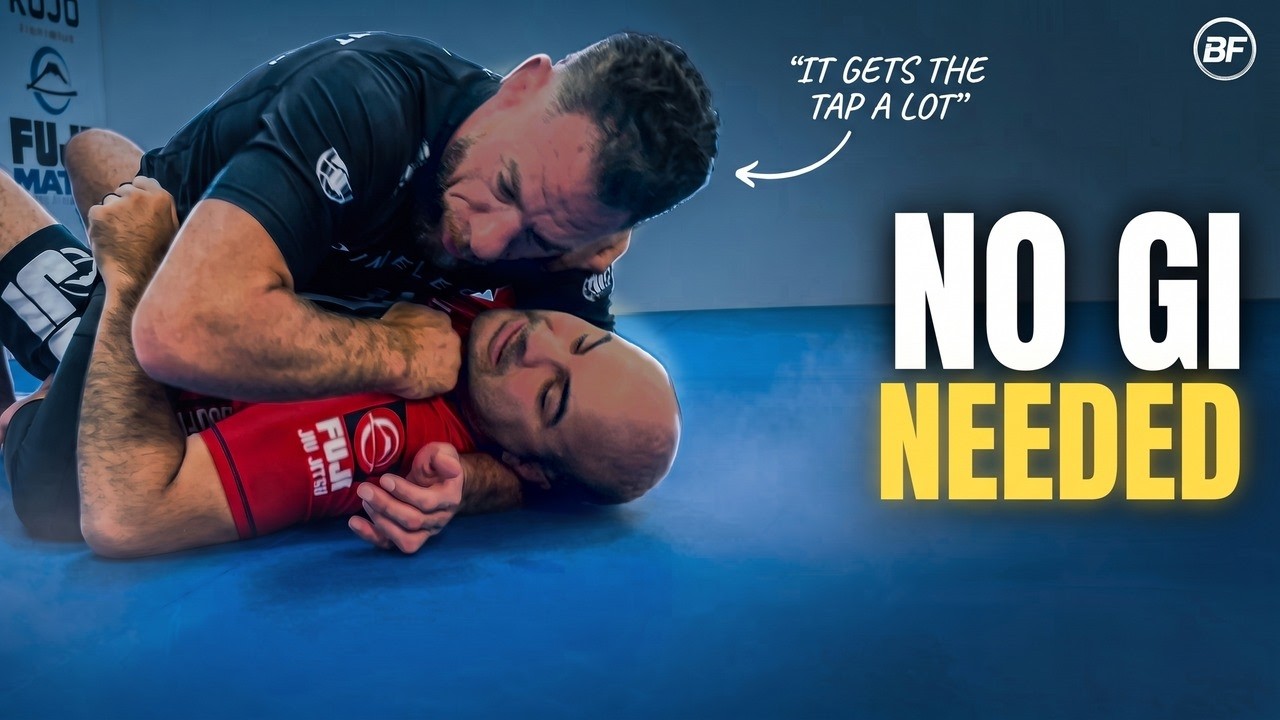
Bernardo Faria's BJJ Fanatics channel hosts Rafael Lovato Jr. for a short lesson on the Ezekiel choke in no-gi, attacked from the Mount. Lovato is an American black belt who won the IBJJF World Championship and later held the Bellator middleweight title. Faria is a five-time IBJJF world champion who runs the instructional site BJJ Fanatics. The video covers how Lovato sets the choke up, how he grips it without a sleeve to hold, and why he treats the tap as a bonus. It suits anyone who can hold the Mount but runs out of attacks once the gi grips are gone.
A submission with a bad reputation 00:00
Faria opens by saying Lovato filmed a full course on Mount attacks without the gi, and that the no-gi Ezekiel is one of his signature moves.
Lovato agrees that most people write the move off. "I think many people think it doesn't work," he said. He points out it has shown up in MMA, sometimes from awkward positions underneath.
His own use is narrower. In no-gi, when he has not yet isolated an arm, the Ezekiel is his first thought. It forces the bottom player to defend, to get nervous, and to move a hand out of position.
He also likes the low cost of the attempt. "If it works, great. If it doesn't work, you open up," he said, meaning the opponent's defensive frames come apart in the process.
Reading the hands first 00:47
Before anything else, Lovato looks at where the bottom player's hands are.
- Both hands planted on his hips: he does not lean forward. Reaching over the head there announces the choke. Instead he goes after the wrists.
- A more conventional defence, with the bottom player shifting frames from side to side: this is when he commits to covering the head.
The decision is about information. If the hands are already low and busy, he takes them. If they are working side to side, the head is available.
Cross-face, head block, climbing knee 01:32
Lovato stresses placing the arm correctly, the same point he makes in his gi Mount material.
- The arm blocks the head on the side the opponent wants to turn toward.
- His own head presses toward the mat to load maximum shoulder pressure and keep the opponent pinned.
- Pinned that way, the bottom player is forced to switch frames and try the other side.
- On the switch, Lovato pulls his knee up and climbs higher in the Mount.
- From the higher position he uses the Cross-Face to shut down that second side.
Faria notes the knee movement as it happens. Each time the bottom player changes the angle of the elbow, Lovato gains another inch upward.
Letting the first scramble burn out 02:17
Instructionals by Rafael Lovato Jr
 No-Gi Mount Masterclass by Rafael Lovato JrView product →
Lovato does not rush the grip. He wants the opening resistance gone first: the pushes, the explosions, the twisting and turning.
The goal is a bottom player who resigns to staying put for a while. To get there he wants the Cross-Face built the way he likes it. Get under the shoulder. Add shoulder pressure. Then connect the head and chin.
At that point the pin is sealed on both sides. His shoulder blocks one side, his head blocks the other.
Building the grip 03:02
Lovato treats the no-gi setup as the same sequence as the gi version, minus the collar.
- His elbow covers the opponent's near arm so it cannot be used to defend, then slides down.
- He pulls his own choking arm out and reaches for his wrist.
- The choking hand stays flat, which he compares to a karate chop, rather than balled into a fist.
- The thumb stays hidden. "I don't want you to be able to grab my thumb," he said, so he tucks it and slips the hand in from the side.
- The elbow drives up to the jawline. "I don't want to put pressure on your throat," he said. "I just want to be on the side of your jawline."
Asked about the fist, Lovato says he sometimes closes it, but worries the opponent's hand crawls in and presses on the thumb.
The squeeze 03:47
With the hand in, he grips his own forearm and wrist and keeps his head down to stay covering the opponent.
The finish is two actions at once. He pulls the gripped arm down while raising the elbow that sits under the head. Everything stays tight against the body.
Faria, on the receiving end, calls it extremely interesting and says the pressure arrives immediately.
The tap is a bonus 04:32
Lovato is direct about what he is actually chasing. "Tapping isn't even my main goal," he said. The opponent's hands were low the whole time. The choke's job is to bring them up.
- If the opponent raises a hand to push the elbow away or lock the biceps, that is a win.
- If the opponent turns hard and reaches a hand behind his back, he lifts the knee higher and starts pressing, with a triangle in mind.
- From the same reaction he can also start working toward a spiral.
Fatigue does the rest. When the bottom player is breathing hard, covered up and simply tired of the position, the tap can come on its own.
Faria draws the distinction between positional training and a match. In competition the guard has already been passed, the points are already lost, and the bottom player is tired. After a few escape attempts have been blocked, Lovato says, you feel the sameness setting in, and that is the moment.
Faria closes by saying he had heard of Ezekiel chokes and seen a video on them, but had never seen anyone teach it that way. The material comes from a course Lovato filmed on attacks and control from deep Mount, due on BJJ Fanatics.
Names and terms
- Rafael Lovato Jr. American black belt, IBJJF world champion, and former Bellator middleweight champion. One of the few grapplers to win at the top level in both jiu-jitsu and MMA.
- Bernardo Faria Brazilian black belt and five-time IBJJF world champion. He runs BJJ Fanatics, an instructional video company, and hosts its YouTube channel.
- Ezekiel choke A choke where the attacker feeds one hand up his own sleeve or forearm and uses that arm across the opponent's neck. With the gi the sleeve provides the grip. In no-gi the hand grips bare forearm, which is why many assume it fails.
- Mount The attacker sits on the opponent's torso, facing them. One of the strongest positions in jiu-jitsu and worth four points in IBJJF competition.
- Cross-Face An arm placed across the opponent's face and jaw to turn their head away and stop them from turning into you. The main pinning tool from the Mount and Side Control.
- Frames The arms or knees placed against the opponent's body to create space. The bottom player's basic tool for escaping, and what Lovato is trying to break down.
Worth watching for anyone whose Mount attacks dry up in no-gi. The lesson is less about the choke itself than about using it as a question that forces the hands to answer, and the detail on hiding the thumb and keeping the hand flat is hard to pick up from text alone.
Sources: Original video (Bernardo Faria BJJ Fanatics). This summary is paraphrased from the video's subtitles.