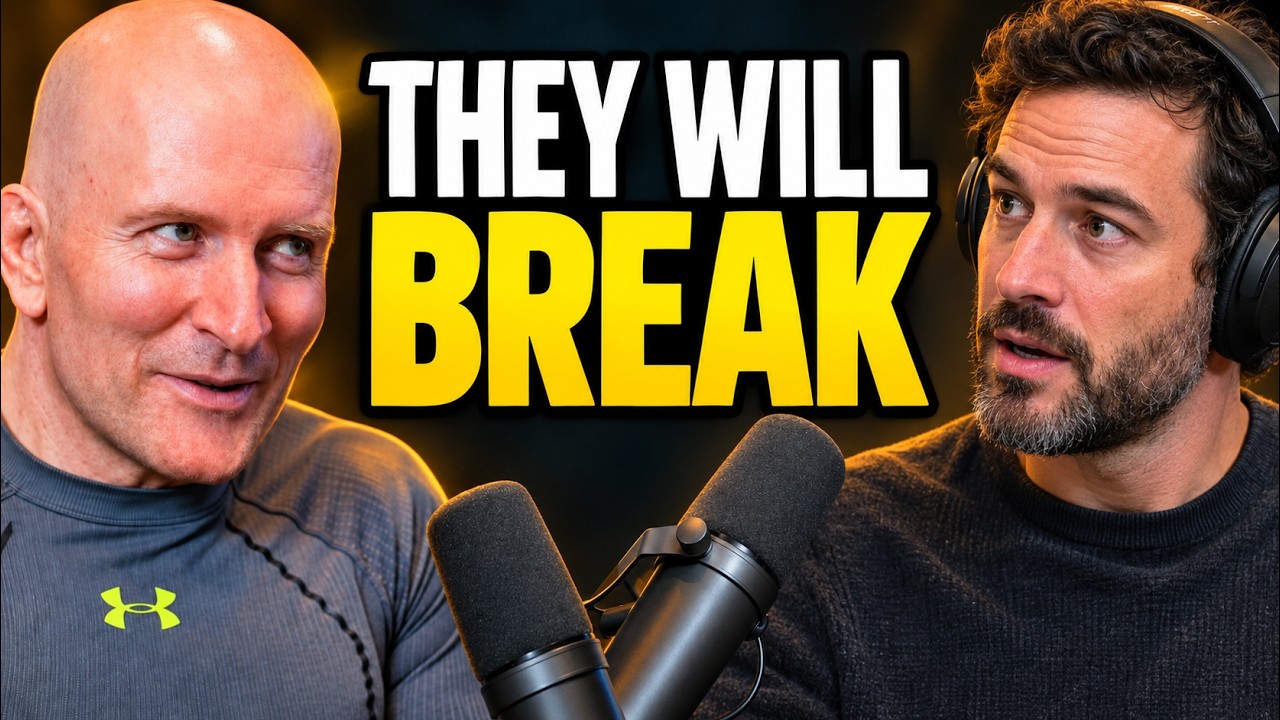
Grappling Archive has posted an interview with John Danaher, the coach behind Gordon Ryan and Gary Tonon.
The main subject is "pressure over time", the idea Danaher says he bolted onto an existing control and submission game.
He also defines "scrimmaging", his format for training the standing game, and explains why he rarely imposes techniques on a student.
The interviewer trained in Danaher's room, so the conversation keeps dropping into specific matches.
It suits readers who want to know how one system produced two very different competitors.
The piece that was missing after EBI 00:00
Danaher opens with an admission about his early years coaching young athletes. What he had built was good enough for EBI, the Eddie Bravo Invitational, a submission-only event with no points and an overtime format. It was not good enough to make legends.
To go further, he said, they had to move beyond a control and submission game and add "the idea of a pressure over time game."
He points to a specific version of one athlete. The Gordon Ryan who entered 2017 against Keenan Cornelius had pressure over time newly built in. Ryan is a multiple-time ADCC champion. Cornelius is an American black belt known for intricate guard work.
Asked what the phrase actually means, Danaher kept it short. "The ability to exert positional pressure over time that melts your opponent."
The interviewer reached for an analogy. "It's almost like playing chess with that little clock." He added the reason it works: "You're going to make a mistake because I'm pressuring you to make a move right now."
Physical pressure and the clock, working together 00:45
Danaher splits the concept in two. "There's two kinds of pressure that are most important. The first is physical and the second is time."
Put them in unison and the effect compounds. "When you can get those two working in unison, you can melt a man inside of 10 minutes."
He uses the Cornelius match as the illustration. Cornelius shot for a takedown "not because he wanted to, but because he had run out of other options." He walked straight into the sequence that won Ryan the match.
The current squad, Danaher said, is a mix of the old submission orientation and pressure over time. Extending that pressure from the ground into the standing position is "a continuing project as we speak."
From situational rounds to scrimmaging 01:32
The interviewer notes a change in vocabulary. The room used to call it situational training: single leg situation, half guard situation. Now there is a scoring rule set attached, and the name is scrimmaging.
Danaher answers by first describing what he does not want. He calls the common approach a "bolt-on philosophy".
- The athlete's real skill set is on the ground.
- A tournament such as ADCC also demands skill in the standing position.
- So the athlete visits a local wrestling club two months out.
- A few wrestling skills get bolted onto the jiu-jitsu game, and the athlete hopes it holds up.
That can work to a point, he said, but it is not how he wants his athletes to think. "I think that the standing game should be built into your jiu jitsu game 365 days a year."
It also has to be tailored to the right rules. Scoring for takedowns in wrestling is substantially different from jiu-jitsu. "The techniques are quite similar, but the scoring criteria is necessarily different."
Why scrimmaging burns more fuel than wrestling 02:19
The interviewer raises the physical cost. "I get more tired scrimmaging than wrestling." In wrestling he is used to a short cycle. Take the opponent down, relax, the scramble is over, start again.
Instructionals by John Danaher
 Master The Move: Omoplata by John DanaherView product →
Danaher agrees. In wrestling the window between the start of the takedown and the end result is short. In jiu-jitsu the scrambles keep running.
"It goes on for an extra 10 seconds, but that 10 seconds could be hell," the interviewer said. Danaher adds the harder part. "There's no guarantee at the end of the 10 seconds because there's no referee."
The bottom man is frantic in those seconds. He does not want the hook coming in. He does not want the pin. An insane amount of energy goes out in a few seconds.
Danaher calls it a fascinating part of the game. He said the younger generation of ADCC athletes is already exhibiting it very well.
Gordon Ryan and Gary Tonon, one system 03:06
The interviewer asks to compare the two games. Both were built in the same system. Both share many similarities and differ sharply.
Tonon, an ADCC veteran known for scrambles and leg locks, gets the warmer description. The interviewer called him "more of a cowboy" and "a wild man", then "the most entertaining grappler" and his favorite.
He adds the trade-off. If Tonon approached the game the way Ryan does, more methodically, he would be less entertaining. He might also have won a few key matches, because the technique and the skill are already there.
Training with Tonon is the most fun in the room, the interviewer said. Tonon will let a partner take his back. He will let a partner get on top and then drill the same escape over and over. He is never in a static position, always on the next maneuver.
Personality, body type, and one forced technique 04:36
Asked whether the difference is personality, Danaher names two factors outside technique. "There's two things that will determine your game. Your personality and your body type."
So the teaching stays the same while the games diverge. "I teach the same techniques to everyone," he said, but each athlete arrives with a different personality and a different body type.
Beyond a few fundamentals he refuses to dictate. "I never impose techniques on people. I tell them what I like." He tells an athlete what he believes would work, then lets the athlete decide. He encourages students to let their own body type and personality build their game organically.
There have been a few exceptions. "I forced Gary Tonon to learn a guillotine because he's so good at scrambling," he said. "I thought it would be a tragedy if he didn't learn a good guillotine."
The interviewer contrasts Ryan's guard. It does not get passed. The opponent gets swept or submitted, or the match is a draw. Very few vulnerabilities.
Danaher frames Tonon's approach as a deliberate gamble. "Part of Gary's modus operandi is to offer opportunities to an opponent." That, he said, "can create some of the most brilliant victories of all time, and it can also lose you a match."
Gary Tonon against Gilbert Burns 05:24
The interviewer calls it one of his favorite matches of all time. He has watched it countless times and refers to it constantly with his students.
Gilbert Burns is a Brazilian black belt and ADCC veteran, known for smash passing and the rear naked choke. He had been a black belt longer than Tonon had been doing jiu-jitsu, and was bigger and stronger on the day.
Tonon's answer was exposure. He willingly let the guard get passed. He turned his back. He handed Burns, of all people, the back take he wanted.
Then he spun into a leg entanglement and locked a heel hook. The interviewer's warning is blunt: no man resists that heel hook, and it is not a pain submission. The knee breaks. Tonon got the tap.
Danaher thinks Ryan would also have won pound for pound, in a completely different way. He would have played guard and eventually found the legs or the sweep. "Gordon is the more high percentage approach. Gary is the more entertaining approach."
Burns came over afterwards. Danaher remembers him as a lovely guy who said, "I was winning that whole match," and then, "out of nowhere he just caught me with that damn heel hook." They showed him the roll again in the lobby of the hotel.
The gut wrench reversal, and the safer option 07:43
The interviewer singles out the entry itself. Old school moves, done in a new way. Tonon went into a wrestling switch and pulled an Ashi Garami out of it, from under a gut wrench.
He explains why that is so draining for the top man. The gut wrench is normally punishment for the bottom man. The top man is about to jump on the back. Nobody wants Burns on their back.
Instead the roles invert. Suddenly the attacker has a man on his leg and has to fight out of it. The scramble keeps going and the fatigue lands on the wrong person.
Asked what Ryan would do from the same spot, Danaher said he would not take that route. "He probably would have hit double trouble." He is also a big fan of Garami rolls. "He would have taken a safer option."
The interviewer's closing read on Tonon is affectionate. A real Rambo. A real commando out there.
Names and terms
- John Danaher: coach of the team that produced Gordon Ryan and Gary Tonon, and the most cited instructor in modern no-gi grappling.
- EBI and ADCC: EBI, the Eddie Bravo Invitational, is a submission-only event with overtime rounds instead of points. ADCC is the biggest submission-grappling world championship and does award points.
- Pressure over time: Danaher's term for positional pressure applied long enough that the opponent runs out of options and takes a bad one.
- Scrimmaging: his training format in which a set situation, such as a single leg or Half Guard, is contested under a points rule set rather than reset after the takedown.
- Ashi Garami: a leg entanglement that traps one of the opponent's legs and sets up leg attacks. The heel hook finished from it twists the knee rather than causing pain, which is why athletes tap early.
- Gut wrench: a wrestling hold in which the top man wraps the opponent's midsection to turn him over. In the match discussed, the man being gut wrenched escaped into a leg attack instead.
This one is for readers interested in coaching method rather than step-by-step technique.
It is also a useful watch for anyone who has wondered why two athletes from the same room compete so differently.
Sources: Original video (Grappling Archive). This summary is paraphrased from the video's subtitles.