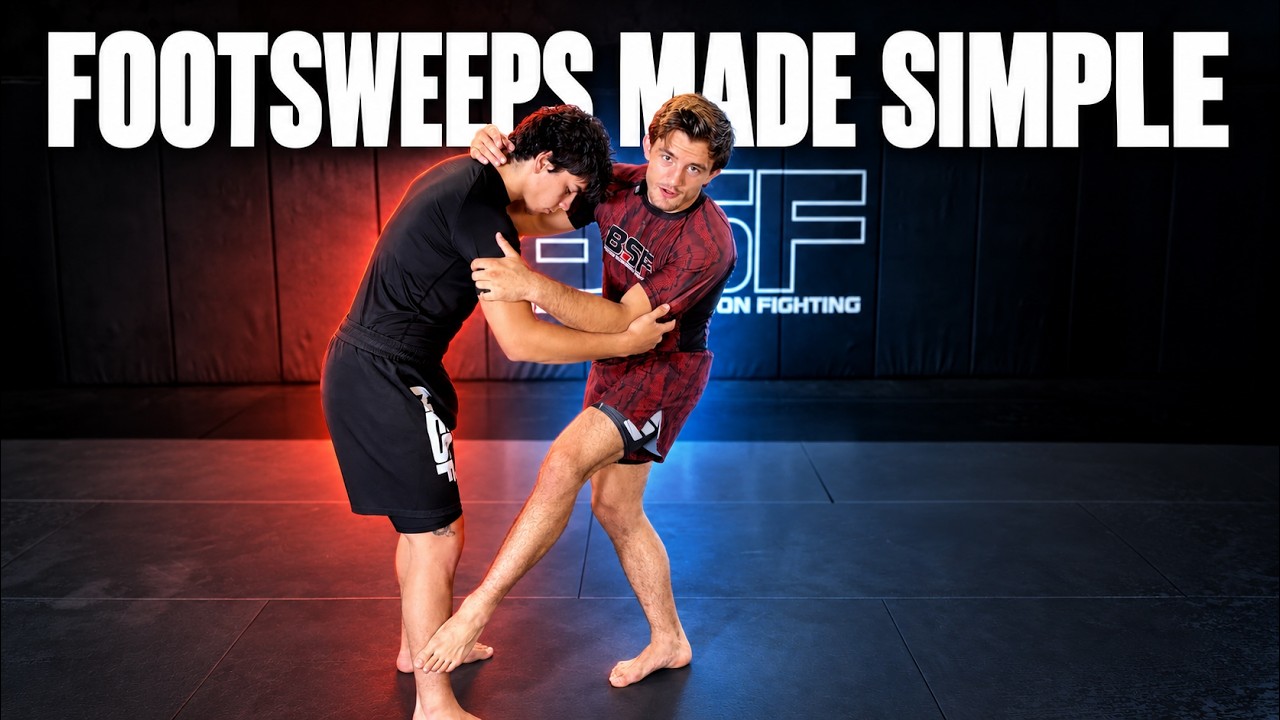
Boston Submission Fighting’s “3 Footsweep Systems for No-Gi BJJ” extends the Massachusetts gym’s sustained push to make standing grappling part of its public teaching identity. The approximately 10-minute, 20-second YouTube lesson follows a run of footsweep videos throughout 2026, including a March long-form tutorial and an August short that reached roughly 950,000 views in a channel-listing snapshot. Its significance lies in that continuing investment in instruction, rather than the introduction of a new technique.
▶ YouTube
For Brazilian jiu-jitsu and submission grappling, the series sits within an established market: regional gyms publish free lessons alongside specialist instructors selling detailed teaching products. Footsweeps already have a substantial history in that market. BSF’s expanding catalog shifts the emphasis toward how a local gym packages those techniques, demonstrates their usefulness without a gi and turns attention into interest in its broader training business.
Footsweeps had a no-gi audience before BSF’s 2026 series
Footsweeps belong to judo’s longstanding repertoire of foot techniques. Their application to BJJ also predates the current wave of short instructional clips. Grappling broadcaster FloGrappling has previously presented inside and outside footsweeps as techniques that could be transferred into jiu-jitsu, though the exact date of that coverage could not be independently confirmed. That precedent matters because it places the current lesson within an existing technical conversation.
The more recent comparison is Justin Flores, the instructor behind the JFLOJUDO channel, whose free explanations include the 2024 video “No-Gi FOOT SWEEPS.” Flores is a separate instructional reference point, not the publisher of BSF’s lesson. His work illustrates how directly the same subject was already being addressed for grapplers training without jacket grips.
The difference is therefore organizational rather than historical. Earlier instruction established the subject and its relevance to BJJ. BSF’s 2026 output shows one gym returning to it across multiple formats, building a recognizable area of instruction instead of treating a footsweep as an isolated demonstration.
That also changes the standard by which a new video can distinguish itself. An established technique does not become more useful simply because another channel demonstrates it. The teaching must help viewers understand the conditions that make it work, while the demonstration must give them a reason to believe those conditions can be created against resistance.
Short clips and longer lessons give BSF two ways to reach grapplers
Boston Submission Fighting, an Arlington, Massachusetts, no-gi jiu-jitsu and MMA gym also known as NESF, began posting repeated footsweep shorts in January 2026. On March 7, it published the longer “Footsweeps Are EASY | Low Risk Takedowns Pt.2.” The August 27 short “Crazy No-Gi Footsweep” subsequently reached approximately 950,000 views in the recorded channel listing.
“3 Footsweep Systems for No-Gi BJJ” adds another extended lesson to that sequence. It was already listed by November 13, when its recorded audience was approximately 23,000 views. Those figures are snapshots, but they show the different scale of attention attached to a brief demonstration and a longer teaching video.
The formats serve different editorial purposes. A short can make the action immediately legible: a standing opponent loses balance and goes down. A longer lesson has room to explain the preparation around that moment. Presenting three systems also frames the subject as something viewers can study across related situations, rather than as a single move to copy.
For BSF, that instructional output sits alongside trial bookings, merchandise and email registration. Free teaching is consequently both a public resource and an entry point to the gym’s business. The audience extends beyond people who can regularly attend classes in Arlington.
Dave Roy, identified by both the gym and Tapology as BSF’s head coach, provides the organizational connection behind that teaching operation. The relevant development is the gym’s repeated commitment to this subject: footsweeps have become a continuing feature of its public output across the year.
Resistance and attribution shape the argument around footsweep videos
The central technical dispute concerns what a successful demonstration proves. A clean sweep can show the intended movement clearly. It does not, by itself, explain how consistently the attacker can establish the necessary position against someone who is actively disrupting the attempt.
Public discussion around no-gi footsweeps repeatedly returns to that distinction. Some viewers emphasize securing a dominant position before attacking the foot. Others question demonstrations in which the receiving partner appears stationary or unusually accommodating. These are different criticisms: one concerns the setup being taught, while the other concerns the conditions under which it is shown.
A separate debate concerns instructional credit. On another BSF footsweep video, a comment reportedly invoked Flores' work and called for acknowledgment, and the channel was said to have replied that techniques are not owned and that Flores is not the only person teaching no-gi judo; the exchange could not be independently verified.
That exchange illustrates the difficulty of distinguishing a shared technical repertoire from an instructor’s particular explanation of it. Footsweeps have a history far longer than either channel. Similar subject matter alone does not resolve a dispute about attribution, just as the age of a technique does not settle whether a specific presentation deserves acknowledgment.
What people are saying
Reactions to other BSF footsweep posts and to no-gi footsweep instruction more broadly cluster around credit, control and the quality of resistance:
- Some viewers want instructors to acknowledge similarities to JFLOJUDO’s explanations.
- Others argue that established judo techniques belong to a shared repertoire.
- Control should come before the sweep; attacking an ankle alone is not enough.
- Stationary or compliant partners make demonstrations less convincing to skeptical viewers.
- Footsweeps can be difficult to learn even when an entry looks simple and effective.
- Timing an opponent’s reaction is seen as more important than forcing the attack.
BSF’s continuing series gives those debates a practical focus. The gym has moved beyond occasional clips to a catalog containing both brief demonstrations and longer lessons. Whether that instruction helps viewers create reliable footsweep opportunities against resisting training partners remains the key question.
Sources: Boston Submission Fighting website and YouTube channel; FloGrappling; JFLOJUDO; Tapology; public r/bjj discussions.